Homeo
Extending W.R. Ashby's generalized homeostasis model to minimally cognitive tasks
The Homeo project investigates whether W.R. Ashby's Generalized Homeostasis Thesis (GHT) — the idea that an organism's primary goal is equilibrium seeking rather than rational planning — can provide a unified theoretical framework integrating emotion and cognition. Cognitive science has long lacked such an integrated account, relying instead on philosophical dualisms of activity/passivity and autonomy/heteronomy that treat affects as secondary to cognition. Homeo proposes that any variation from an organism's equilibrium produces an affect that prompts corrective action, grounding all behavioral capacities in affects rather than in rational deliberation. The project tests this model empirically through evolutionary robotics simulations with homeostatically controlled agents performs minimally cognitive tasks.

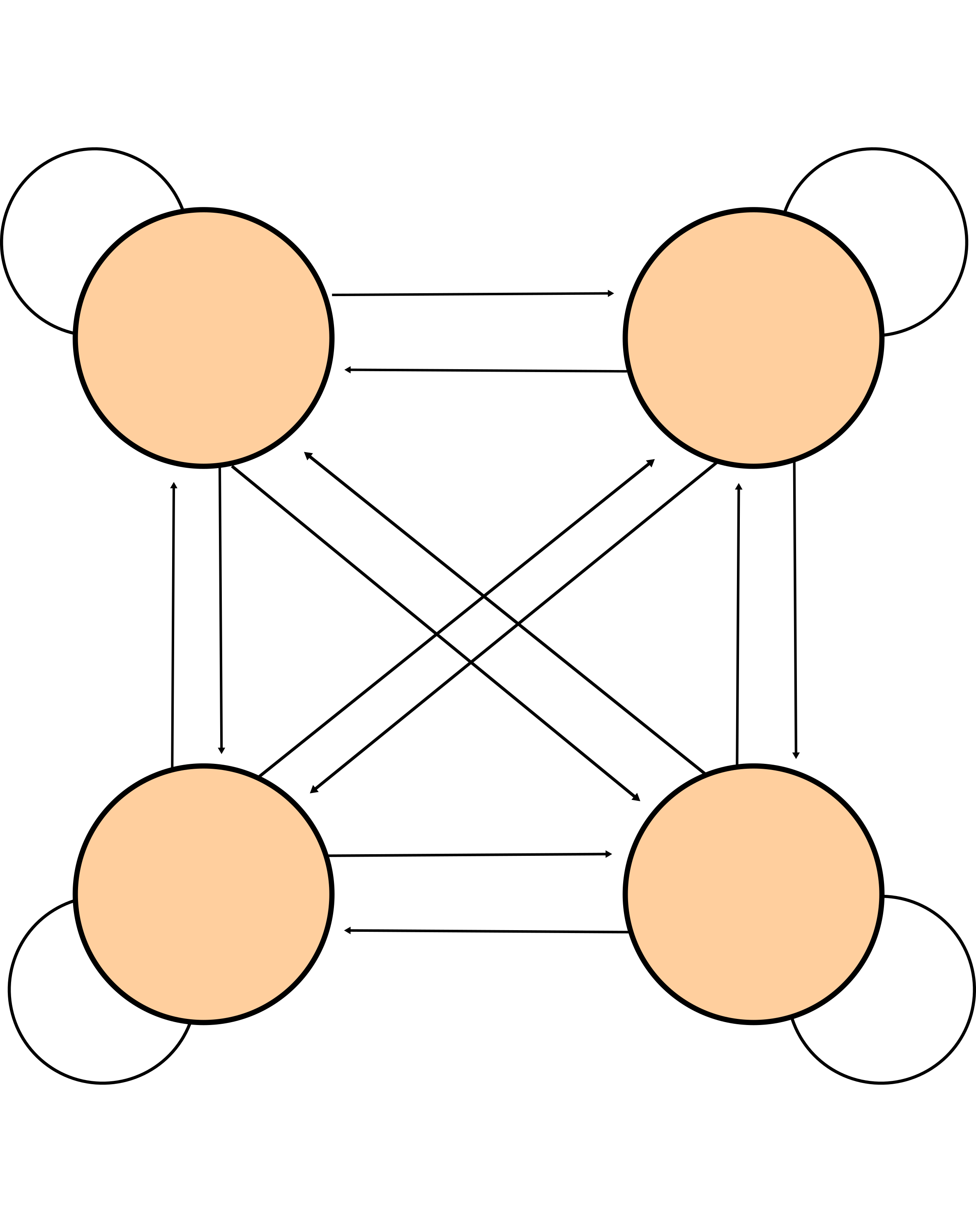

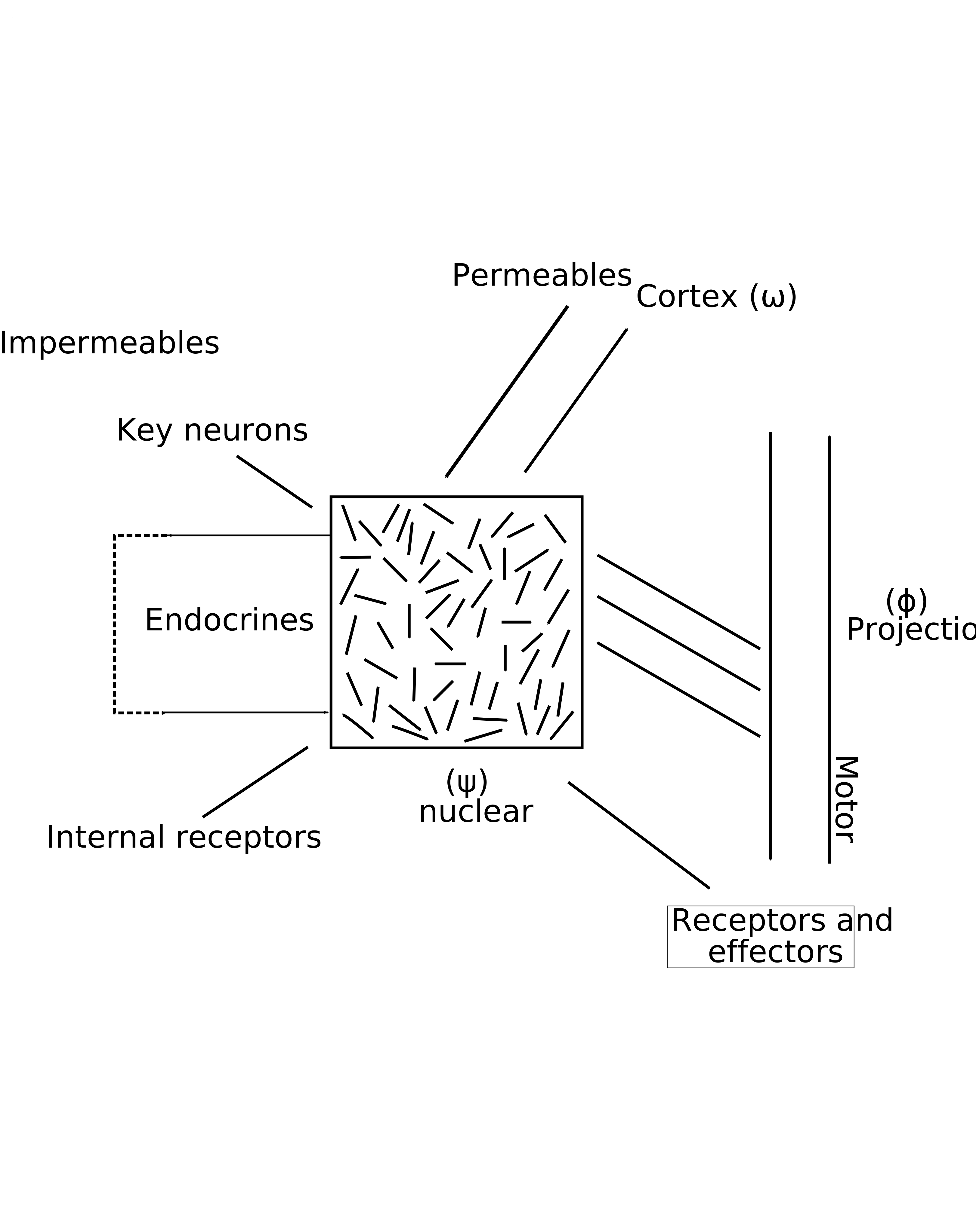
On the left, the topology of Ashby’s Homeostat depicted on the top right image. Middle, Edward Weston’s pepper showing equilibrium seeking strategies as producers of new forms. On the right, the homeostatic schema of the human nervous system according to Freud and Breuer.1
Detailed description
overview
Evidence coming from psychology, economics, political science, robotics and AI, not to speak of philosophy, shows that affective relations between agents and their environments determine human and non-human behavior more than rational planning.2 Some have even suggested that we could attribute traumatic events such as the 2008 financial crisis to an over-reliance on the role of rationality in human behavior.3
Yet, cognitive science still lacks an integrated theoretical framework that would give affections a primary role in the performance of cognitive tasks. Psychology’s dominant paradigm treats emotions as the result of an agent’s appraisal of the relationship between external events and its beliefs, desires, and intentions, thereby reducing their role to “coloring” our thoughts with an emotional tinge.4 Likewise, while no one denies affections’ powerful role in, say, democratic elections, the call is to purge them from a democratic process worth its name. Paradoxes such as these have timely implications for European society, whose underlying issues the proposed research addresses with a specific, multi-disciplinary approach. The obstacle toward a needed affect-based account of behavior lies in the ill-fated reliance of cognitive science and philosophy of mind on the philosophical conceptual pairs activity/passivity and autonomy/heteronomy. Instead, the research proposes that an organism’s primary and only goal is general homeostasis or equilibrium seeking, as it strives to keep itself in a stable relationship with the environment it depends on. Any variation from equilibrium produces an affect prompting corrective actions. A fully homeostatic model of behavior will therefore ground all organism’s capacities in affects. Through evolutionary robotics techniques applied to affective and minimally cognitive tasks, the project will empirically test this model of behavior and show that it overcomes the traditional obstacles to an integrated model of affection and cognition.
background
Affects are intrinsically related to the body. They are the internal perceptions of a change in somato-visceral states signaling the positive or negative valence of the environment’s effects on the agent. They express the body’s heteronomous dependence on its surroundings. Cognition is the autonomous capacity of the mind to know the objects it confronts. Historically speaking, biology and cognitive science have produced three alternative views regarding the autonomy/heteronomy, mind/body dualism. The first one makes the mind as similar to the body as possible by turning it into a machine, as 18th century’s Mechanicism, 19th century’s reflexology and psychoanalysis, and the recent school of evolutionary psychology did. The trade-off is a drastic reduction in the scope of autonomous agency, as evident in Freudian psychoanalysis and evolutionary psychology. The second alternative makes the body more similar to the mind by downplaying or eliminating its mechanical character. Embedded Cognition (EC), which has emerged as an alternative research paradigm in cognitive science, AI, robotics, and philosophy in the last twenty years, currently favours this approach.5 Its followers endorse Hans Jonas’s identification of philosophical autonomy in less and less organized forms of life, thus viewing all forms of metabolism, from bacteria upward, as containing the kernel of Kantian freedom.6 The trade-off is that EC ‘cognitivizes’ bodily affects and reduces the dependency of the individual on the environment. The third alternative is a compromise solution. To distinguish emotion from cognition, researchers focus on the mechanisms the brain uses: functions ruled by homeostatic processes are viewed as emotional, while non-homeostatic functions are considered cognitive.7 Unfortunately, this view reintroduces the unwelcome split in human life, albeit at the level of the brain mechanisms implementing emotional/cognitive processes.8
We can overcome the dualism all these approaches and theories variedly underwrite only if we reconsider their implicit philosophical foundations. Homeo sets to do just that by considering homeostasis, or equilibrium seeking, as the only mechanism underlying emotional as well as cognitive processing. W. R. Ashby was the first researcher to introduce the concept of general homeostasis.9 He characterized all living beings as ultimately purposeless organisms moving around their environments with no definite goals except healthy survival. An organisms strives to keep the value of some essential variables (energy level, security, etc.) within tolerable limits—in equilibrium—by randomly selecting courses of actions out of a repertoire of possibilities. Ashby claimed that this hypothesis—the Generalized Homeostasis Thesis (GHT)—was flexible enough to explain behavior we normally attribute to high-level planning. As Damasio noted, in spite of its early inception and ubiquitous applications in biology and medicine, the essential role of homeostasis in the regulation of all of life’s processes did not receive neurobiology’s and psychology’s attention until recently.10 Varela and Maturana’s view of life as autopoiesis incorporated some of Ashby’s view of homeostasis. However, the primacy of an agent’s activity typical of their Jonas-inspired theory led them to disregard Ashby’s radical insights.11 EC’s renewed interest in the role of the body in cognitive processes and its partial integration of Ashby’s approach have sparked new interest in homeostasis.12 Researchers coming from fields as diverse as evolutionary robotics, the neurosciences, and even the philosophy of cognitive science have revived and adapted Ashby’s theory.13 Yet, these authors have not attempted to validate Ashby’s original approach in all its conceptual breadth. Some have integrated Ashby’s technical contributions into more traditional models of cognition.14 Others have used the concept of homeostasis to provide a more sophisticated model of neural activity.15 But no one has put to the test the original and far more reaching general thesis about homeostasis, from the empirical as well as from the theoretical points of view. Homeo seeks to do just that: it recovers the full scope of Ashby’s general homeostasis and deploys it as an explicit critique of activity-centered accounts toward a holistic re-evaluation of the behavioral role of affects and drives. As Jonas clearly saw,16 GHT’s stress on equilibrium and, consequently, on inactivity as life’s primary goal throws a wrench into the traditional autonomy/heteronomy distinction. The common link between the two concepts upheld by the traditional view lies in the primacy of action: life includes only autonomous leaders or heteronomous followers, as it were. But homeostatic life is neither: it follows (heteronomous) but, as it does so, it makes up its own rules(autonomous). And yet it makes its own rules (autonomous), though only when the environment forces it to do so (heteronomous).17 No wonder the first witnesses to the device Ashby had built to illustrate GHT—the original Homeostat—could hardly wrap their heads around it.18
In previous published work,19 I conducted a thorough historical analysis and conceptual reconstruction of GHT, following its development from 19th and early 20th century biological theories, through its cybernetic transformations in Wiener and Ashby, its adoption by the autopoiesis school, up to its recent partial reincarnations in the work of contemporary roboticists. Those results showed that Ashby’s homeostatic theory of the mind entails both an unorthodox philosophical theory about life that sees emotion and cognition as different manifestations of the same underlying homeostatic mechanism and, at the same time, a series of technical solutions providing a formal model of homeostasis. Moreover, my work showed that due to the technological limitations of the experimental apparatuses he had to use, Ashby could not properly test his radical views. Now that time has come. Whereas recent re-enactments of Ashby’s theory have laudably managed to recover some of the technical aspects of GHT, now we should turn our attention to Ashby’s so far neglected conceptual aspects. A fuller assessment of GHT requires that we test a GHT-based model of cognition on standard tasks. Therefore, Homeo sets to experiment whether (simulated) autonomous robots directed by homeostasis-only controllers can successfully perform a range of affects-based and cognition-based tasks. Homeo will then examine possible extensions of GHT to minimally social tasks.20
goals
- Monomodal affective tasks — phototaxis with hunger-like drives
- Minimally cognitive tasks — categorial discrimination
- Mixed affective and cognitive tasks — resolving implicit conflicts
Homeo’s overall goal is to show that once we remove the traditional philosophical opposition between autonomy and heteronomy, we can locate the foundation of a fully integrated emotion-cognition framework in GHT. I provided the first theoretical articulation of this stance in earlier published work.21 Through the use of evolutionary robotics methodology, I expect to confirm and extend his theory by showing that we can interpret cognitive as well as affective tasks as instances of an agent’s homeostatic adaptations. Early results from a prototype I developed are encouraging.22 Homeo, thereofre, therefore three interrelated objectives:
-
Test the GHT framework in monomodal affective tasks.
Show that homeostasis-controlled robots can carry out phototaxis and possibly other kind of tactic tasks, while experiencing an internal hunger-like drive produced by slowly discharging batteries. Systematic lesion studies will test the robustness and limitation of the GHT theoretical framework.
-
Test the GHT framework in minimally cognitive tasks.
Show that homeostasis-controlled robots can carry out minimally cognitive tasks involving standard categorial discrimination while being driven by homeostasis-generated affects.23
-
Test the GHT framework in mixed affective and cognitive tasks.
Show that homeostasis-controlled robots can pursue simultaneously an affective and a minimally cognitive task, thereby resolving the implicit conflict by relying on the primacy of affects that homeostasis provides.
methodology
Evolutionary robotics has proved to be a useful tool for the study of basic theories of behavior.24 Its method consists in developing virtual stylized scenarios in which simulated robots, controlled by an algorithm that translates a general theory of behavior into robotic controllers, carry out different tasks. The simulated robots are then tested on their performance in the chosen tasks—photo- and chemo-taxes; discrimination among geometric figures—in varied environments and different bodily conditions, including lesions. Successful completion of the tasks provides a measure of validation for the theoretical model of organism/environment interaction that the robotic environment embodies
Homeo follows this methodology, but it applies a different model of behavior based on general homeostasis (GHT). Di Paolo and others have explored minimally affective tasks.25 Once equipped with internal batteries rechargeable by approaching a light source, robots perform phototaxis by reaching the source on the basis of the stimuli coming from sensors located on the opposite side of their bodies. Since the motivator (the ‘affect’ or ‘drive’) of the robot’s behavior is its need to maintain the perceived battery level above a minimal threshold, the robot’s monitoring of the battery level becomes a proxy for a living organism’s interoception of its somato-visceral states. This behavior is a paradigm of ‘affective’ behavior. Beer has proposed a similar model for “minimally cognitive,” not affective, tasks.26 His model entails a categorial discrimination between moving circles and squares. Because the latter is a paradigmatic example of cognitive behaviors, we can use it as a proxy for the assessment of the mechanism directing it. Unlike Di Paolo’s and Beer’s, though, if a robot that is purely homeostatic—hence affect-based—successfully completes a cognitive categorical discrimination task, then a model of behavior centred on affective responses such GHT will account for important aspects of cognition. The successful completion of the proposed tasks by a fully homeostatic robot will have achieved the primary goal of the proposed research: developing an alternative unified theoretical framework that integrates emotion and cognition.
software
The simulation package is available on GitHub under GPL v.3.
notes
-
I put forward a detailed defense of the homeostatic interpretation of Freud’s theory of the mind and, more generally, of psychoanalysis in the second, forthcoming volume of my latest book: Stefano Franchi, Life, Described, vol. 2, The Passion of Life (Critical, Cultural and Communications Press, 2026).. ↩
-
Daniel Kahnemann, Thinking Fast and Slow (Farrar, Straus and Giroux, 2011); Eric Groenendyk, “Current Emotion Research in Political Science: How Emotions Help Democracy Overcome Its Collective Action Problem,” Emotion Review 3, no. 4 (2011): 455–63; Rodney Brooks, Cambrian Intelligence: The Early History of New AI (MIT Press, 1999); Jesse Prinz, The Emotional Construction of Morals (Oxford University Press, 2007); Martin Heidegger, Being and Time, trans. by Joan Stambaugh (State University of New York Press, 1996). ↩
-
E.g. Jon Elster, L’Irrationalité: Traité Critique De l’Homme Économique, vol. 2 (Seuil, 2010); George A. Akerlof and Robert J. Shiller, Animal Spirits: How Human Psychology Drives the Economy, and Why It Matters for Global Capitalism (Princeton University Press, 2009).. ↩
-
Klaus S. Scherer et al., eds., Appraisal Processes in Emotion: Theory, Methods, Research (Oxford Univ Press, 2001).. ↩
-
Julian Kiverstein, “The Meaning of Embodiment,” Topics in Cognitive Science 4, no. 4 (2012): 740–58; Ron Chrisley, “Embodied Artificial Intelligence,” Artificial Intelligence, no. 149 (2003): 131–50; Michael L. Anderson, “Embodied Cognition: a Field Guide,” Artificial Intelligence, no. 149 (2003): 91–130.. ↩
-
Hans Jonas, The Phenomenon of Life: Towards a Philosophical Biology (Harper and Row, 1966); Hans Jonas, The Imperative of Responsibility. Foundations of an Ethics for the Technological Age (Chicago University Press, 1984).. ↩
-
Luiz Pessoa, “On the Relationship between Emotion and Cognition,” Nature Reviews. Neuroscience 9, no. 2 (2008): 148–58., p.154. ↩
-
Stefano Franchi, Cognition as Second Order Regulation, ed. by Vincent Müller, Sinthese Library (Springer, 2016), 375:167–78.. ↩
-
W. Ross Ashby, Design for a Brain, 1st ed. (John Wiley and Sons, 1952).. ↩
-
Antonio Damasio, Self Comes to Mind: Constructing the Conscious Brain (Knopf Doubleday, 2010).. See Stefano Franchi, Cognition as Second Order Regulation, ed. by Vincent Müller, Sinthese Library (Springer, 2016), 375:167–78. for a critique. ↩
-
Francisco J. Varela, Principles of Biological Autonomy (North Holland, 1979); Humberto R. Maturana and Francisco J. Varela, Autopoiesis and Cognition: The Realization of the Living, Boston Studies in the Philosophy and History of Science (Reidel, 1980); Xabier E. Barandiaran and Kepa Ruiz-Mirazo, “Modelling Autonomy: Simulating the Essence of Life and Cognition,” Biosystems 91, no. 2 (2008): 295–304, https://doi.org/DOI: 10.1016/j.biosystems.2007.07.001; Andreas Weber and Francisco J. Varela, “Life after Kant: Natural Purposes and the Autopoietic Foundations of Biological Individuality,” Phenomenology and the Cognitive Sciences 1, no. 2 (2002): 97–125.; see Stefano Franchi, “Homeostats for the 21st Century? Lessons Learned from Simulating Ashby Simulating the Brain,” Constructivist Foundations 8, no. 3 (2013): 501–32. for a critique. ↩
-
Francisco J. Varela et al., The Embodied Mind: Cognitive Science and Human Experience (MIT Press, 1991); Ezequiel Di Paolo et al., “Horizons for the Enactive Mind: Values, Social Interaction, and Play,” in Enaction: Towards a New Paradigm for Cognitive Science, ed. by John Stewart et al. (MIT Press, 2010).. ↩
-
Ezequiel {Di Paolo}, “Organismically-Inspired Robotics: Homeostatic Adaptation and Teleology Beyond the Closed Sensorimotor Loop,” in Dynamical Systems Approach to Embodiment and Sociality, ed. by K. Murase and T. Akasura (Advanced Knowledge International, 2003); Ezequiel Di Paolo, “Extended Life,” Topoi 28, no. 1 (2009): 9–21; Gina Turrigiano, “Homeostatic Signaling: the Positive Side of Negative Feedback,” Current Opinion in Neurobiology 17, no. 3 (2007): 318–24; Margaret A. Boden, Mind as Machine: a History of Cognitive Science (Oxford University Press, 2006).. ↩
-
Ezequiel {Di Paolo}, “Organismically-Inspired Robotics: Homeostatic Adaptation and Teleology Beyond the Closed Sensorimotor Loop,” in Dynamical Systems Approach to Embodiment and Sociality, ed. by K. Murase and T. Akasura (Advanced Knowledge International, 2003).. ↩
-
Gina Turrigiano, “Homeostatic Signaling: the Positive Side of Negative Feedback,” Current Opinion in Neurobiology 17, no. 3 (2007): 318–24.. ↩
-
Hans Jonas, The Imperative of Responsibility. Foundations of an Ethics for the Technological Age (Chicago University Press, 1984).. ↩
-
Stefano Franchi, General Homeostasis, Passive Life, and the Challenge to Autonomy, ed. by Vincent Müller, Synthèse Library (Springer, 2016), 283–98, https://doi.org/10.1007/978-3-319-26485-1_17.. ↩
-
Heinz von Foerster et al., eds., Cybernetics. Circular Causal and Feedback Mechanisms in Biological and Social Systems. Transactions of the Ninth Macy’s Conference, March 20-21, 1952, New York, N.Y. (Josiah Macy, Jr. Foundation, 1953).. ↩
-
Stefano Franchi, “Life, Death, and Resurrection of the Homeostat,” in The Search for a Theory of Cognition: Early Mechanisms and New Ideas, ed. by Stefano Franchi and Francesco Bianchini (Rodopi, 2011); Stefano Franchi, “Jammed Machines and Contingently Fit Animals: Psychoanalysis’s Biological Paradox,” French Literature Series 38 (2011): 213–56; Stefano Franchi, “Can Machines Have an Unconscious? Would They Have To?,” in Proceedings of the VIII European Conference on Philosophy and Computing (ECAP), ed. by Rainhard Zvi Bengez (Verlag Dr. Hut, 2010).. ↩
-
Thomas Froese and Ezekiel A. Di Paolo, Toward Minimally Social Behavior: Social Psychology Meets Evolutionary Robotics, ed. by G. Kampis et al. (2009), 420–27.. ↩
-
Stefano Franchi, “Life, Death, and Resurrection of the Homeostat,” in The Search for a Theory of Cognition: Early Mechanisms and New Ideas, ed. by Stefano Franchi and Francesco Bianchini (Rodopi, 2011); Stefano Franchi, “Jammed Machines and Contingently Fit Animals: Psychoanalysis’s Biological Paradox,” French Literature Series 38 (2011): 213–56; Stefano Franchi, “Can Machines Have an Unconscious? Would They Have To?,” in Proceedings of the VIII European Conference on Philosophy and Computing (ECAP), ed. by Rainhard Zvi Bengez (Verlag Dr. Hut, 2010); Stefano Franchi, General Homeostasis, Passive Life, and the Challenge to Autonomy, ed. by Vincent Müller, Synthèse Library (Springer, 2016), 283–98, https://doi.org/10.1007/978-3-319-26485-1_17.. ↩
-
Stefano Franchi, “Homeostats for the 21st Century? Lessons Learned from Simulating Ashby Simulating the Brain,” Constructivist Foundations 8, no. 3 (2013): 501–32; Stefano Franchi, General Homeostasis, Passive Life, and the Challenge to Autonomy, ed. by Vincent Müller, Synthèse Library (Springer, 2016), 283–98, https://doi.org/10.1007/978-3-319-26485-1_17.. The developed software is publicly available at https://github.com/cleinias/Homeo. ↩
-
Stefano Franchi, “Life, Death, and Resurrection of the Homeostat,” in The Search for a Theory of Cognition: Early Mechanisms and New Ideas, ed. by Stefano Franchi and Francesco Bianchini (Rodopi, 2011).. ↩
-
Patricia A. Vargas et al., The Horizons of Evolutionary Robotics, Intelligent Robotics and Autonomous Agents (MIT Press, 2014); Inman Harvey et al., “Evolutionary Robotics: a New Scientific Tool for Studying Cognition,” Artificial Life 11, no. 1–2 (2005): 79–98; Stefano Nolfi and Dario Floreano, Evolutionary Robotics: the Biology, Intelligence, and Technology of Self-Organizing Machines (MIT Press, 2000). ↩
-
Ezequiel {Di Paolo}, “Organismically-Inspired Robotics: Homeostatic Adaptation and Teleology Beyond the Closed Sensorimotor Loop,” in Dynamical Systems Approach to Embodiment and Sociality, ed. by K. Murase and T. Akasura (Advanced Knowledge International, 2003); Takashi Ikegami and Keisuke Suzuki, “From a Homeostatic to a Homeodynamic Self,” Biosystems 91, no. 2 (2008): 388–400.. ↩
-
Randall D. Beer, “The Dynamics of Active Categorical Perception in an Evolved Model Agent,” Adaptive Behavior 11, no. 4 (2003): 209–43, https://doi.org/10.1177/1059712303114001.. ↩